Inflating and Deflating Kayaks, Sleeping Pads and Pool Floats
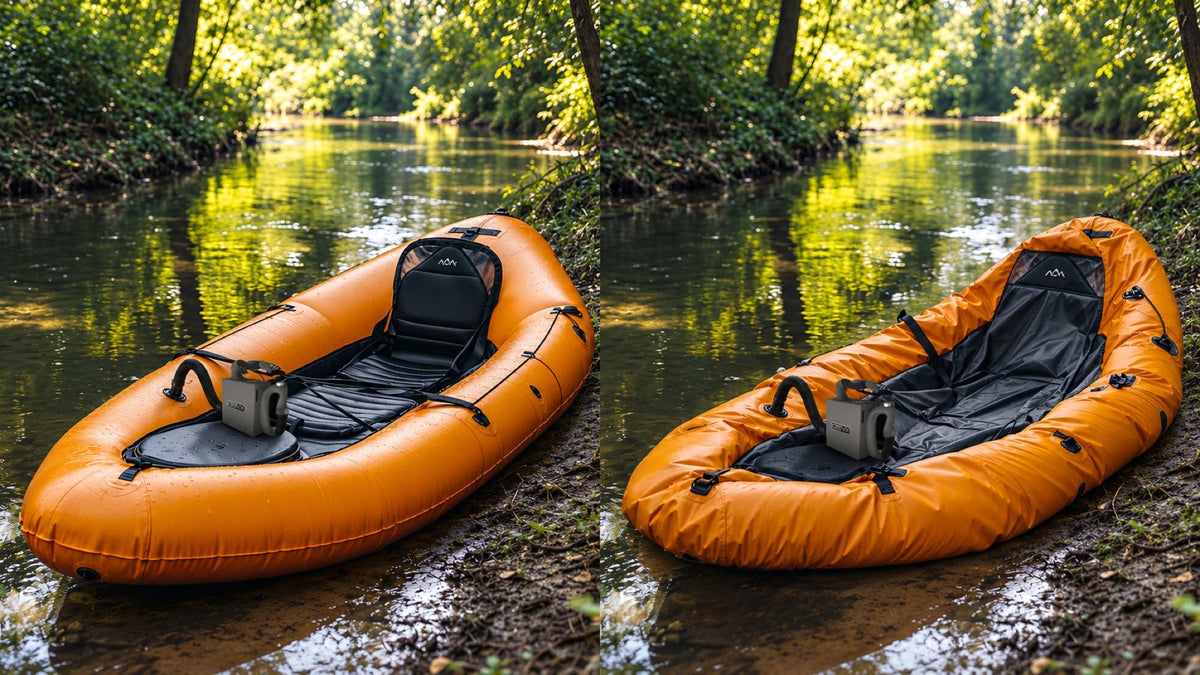
Inflatable gear makes car camping easy: a kayak that fits in the trunk, a pad that rolls up to the size of a water bottle, a float for the lake. The catch is the air. Getting it in takes effort, getting all of it out takes patience, and a little care at both ends keeps seams and valves in good shape season after season.
Start with the valve
Most trouble with inflatables comes from a pump that doesn’t seal on the valve. Find out which kind you have before the trip:
- Boston valves (kayaks, air mattresses, big floats) have two parts. Unscrew the cap to fill through a one-way flap; unscrew the whole base to let the air rush out.
- Spring-loaded push valves (many kayaks and paddle boards) let air in but not out when the center pin is up. Press and twist the pin to lock it open for deflating. These usually need a matching adapter.
- Sleeping pad valves often have a small one-way port for filling and a larger port for dumping air.
- Pinch and stem valves on pool toys and small floats need a narrow nozzle.
Test the fit at home. If air hisses out around the joint, try a different pipe or nozzle, or cup your hand around the connection to seal it while you fill.
Filling to the right firmness
- Find the maker’s number. Pressure guidance is usually printed near the valve or in the manual. For many inflatable kayaks it’s lower than people expect.
- Follow the fill order. Multi-chamber kayaks often want the floor first, then the side tubes a little at a time so the hull stays straight.
- Know what a blower can do. Blowers move a lot of air at low pressure. They fill volume; high-pressure gear such as paddle boards and drop-stitch floors needs a pump made for that pressure, usually a hand pump with a gauge, to reach the listed PSI.
- Don’t overinflate. Seams take the strain, and a chamber filled hard in the morning shade can get tight once the sun is on it.
- Skip breath-filling pads when you can. Breath carries moisture inside, which can lead to mildew, and in freezing weather that moisture can freeze inside the pad.
Sun, cold water and topping off
Air expands as it warms up and contracts as it cools. A kayak left on a sunny beach can firm up past where you set it, so park it in the shade or let a little air out. Launch into cold water and the opposite happens: the chambers soften, and a short top-off at the shore brings the stiffness back.
Sleeping pads do the same overnight. A pad that felt firm at sunset can feel soft by midnight as the tent cools, which is normal and not always a leak. Add a little air and check again in the morning.
Deflating flat for packing
- Open the deflate side fully: unscrew a Boston base, or lock a push valve open.
- Let the bulk of the air escape on its own.
- Pull out what is left with suction, or by rolling from the far end toward the open valve.
- Close the valve as soon as it’s flat so air doesn’t creep back in.
- Fold to the width of the storage bag and roll toward the valve. Kayaks fold most neatly along the lines they came with.
Storage between trips
- Rinse off sand, salt and lake water with fresh water, then dry inside and out with the valves open. Packing gear damp traps moisture in the folds.
- Store everything cool, dry and out of direct sun, since heat and UV age PVC and coatings.
- Keep self-inflating foam pads unrolled with the valve open so the foam can recover. Air pads and floats can be stored loosely rolled.
- Keep kayaks off concrete floors and away from rodents and sharp tools.
- Before the next trip, do a test fill at home and listen for slow leaks.
Paddling from camp? Our guide to camping near creeks and rivers covers choosing a safe site by moving water.
GENX at the put-in
The GENX All-in-1 CampCare Tool inflates and deflates kayaks, pads and floats through its two air pipes, one straight and one bent. It runs on its own battery, so there’s no outlet to find at the lake. Check at home that a pipe seals on your valve; push-valve kayaks may still need their own adapter. Follow your inflatable maker’s pressure guidance, don’t overinflate, and finish high-pressure boards with a pump and gauge made for them. When the boats are packed, the pipes and nozzles go back in the hard case.

