Chimney Starter vs Torch vs Electric Starter: Which Fits You?
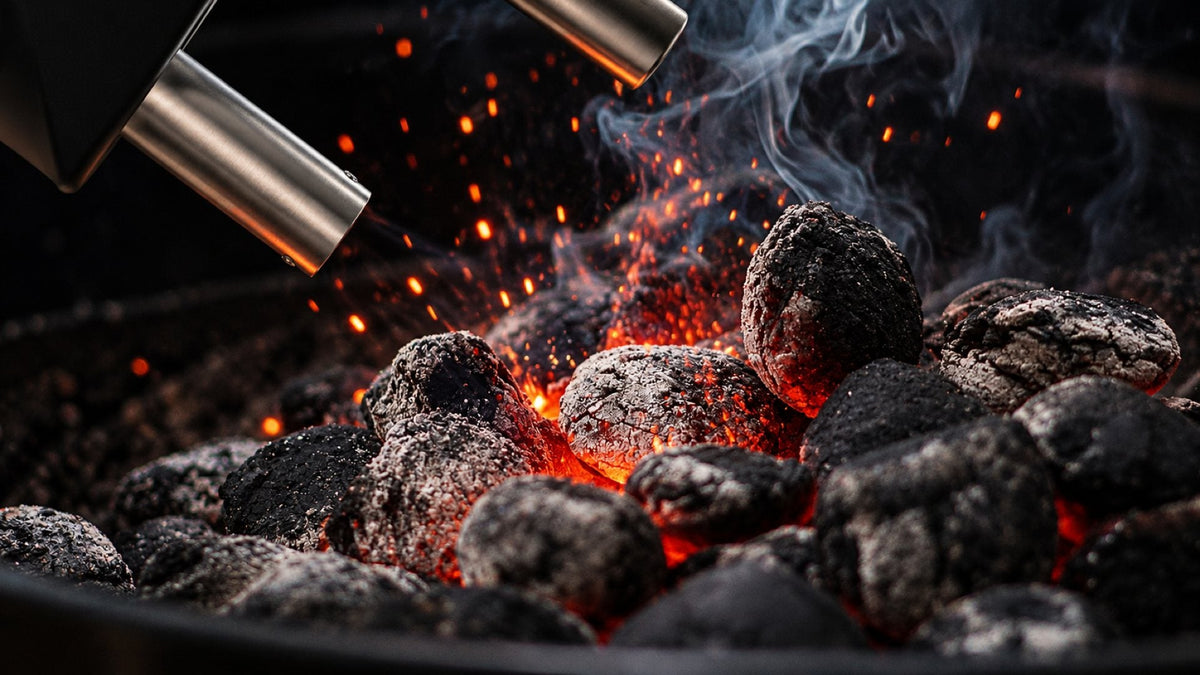
Lighter fluid used to be the default way to start a charcoal grill. Today most backyard cooks and campers choose between three fluid-free methods: a chimney starter, a butane torch and an electric starter. All three light charcoal well. They differ in how much attention they need, what they cost to run, how much mess they leave and where they work. This guide lays out each one plainly so you can pick by how and where you grill.
Chimney starter
A chimney is a metal cylinder with a grate near the bottom and a handle on the side. Charcoal goes on top, crumpled paper or a starter cube goes underneath, and the tall shape draws air up through the pile once the starter is lit.
- Time: Typically somewhere between 10 and 40 minutes, depending on the charcoal, the amount and the weather, and on how ready you want the coals. Weber's guide says the coals are usually lit enough to pour in about 10 to 15 minutes. America's Test Kitchen allows 20 to 40 minutes for the top layer to be fully covered in white ash.
- Cost: Typically the cheapest of the three to buy, and it runs on paper or starter cubes.
- Mess: Burned newspaper leaves light ash that can drift; starter cubes are tidier.
- Safety: The whole chimney gets extremely hot. Wear heat-proof gloves, pour carefully, and set the empty chimney to cool on a nonflammable surface, away from feet, kids and pets.
- Weak spots: It is bulky in a camp bin, and a small batch takes about as long as a full one.
Butane torch
A torch lighter burns butane as a focused jet. You can use it two ways: to light the paper or the bottom coals of a chimney, or to light a few coals directly in the grill with no chimney at all.
- Time: Depends on how much charcoal you light. A torch is quickest for a small batch and pairs well with a chimney for a full load.
- Cost: A refillable torch costs more than a chimney up front, then runs on standard butane refill cartridges.
- Mess: Next to none. No paper ash and no residue on the coals.
- Safety: Choose a torch with a lock/unlock switch and keep it locked when stowed. Refill it outdoors, away from flames, never point it at people or pets, and keep it away from children.
- Weak spots: You have to hold it while it works, butane performs poorly near freezing, and lighting a big pile from one spot is slow unless you add air.
A torch has a second job at the grill, too: see how to sear a steak with a butane torch.
Electric starters
Electric starters come in two common styles.
Coil starters
A looped metal element on a handle. You nestle the loop into the charcoal, plug it in, and the element glows until the coals around it catch. Then you pull it out and set it somewhere safe.
Air-blast igniters
A handheld wand with a fan behind a heating element. You hold the tip against the charcoal and the air leaving the tip is hot enough to light it; once the coals catch, the same airflow fans them.
- Time: Varies by model and load. Air-blast igniters light and fan at once, so they tend to work faster; coil starters are slower and more hands-off.
- Cost: Typically more than a chimney to buy, with no fuel to buy afterward, just electricity.
- Mess: Clean. No paper and no fuel smell.
- Safety: The element stays dangerously hot after you switch it off. Rest it on a nonflammable surface, keep the cord out of walkways and away from the grill, and use an outdoor-rated extension cord.
- Weak spots: Most need a wall outlet, which rules them out at many campsites and tailgates unless you carry a power station that can handle the load.
Side by side, in plain terms
- Least hands-on: a chimney or a coil starter. Set it up and step back, but stay nearby.
- Most portable: a torch. It fits in a camp kit and needs no outlet.
- Lowest running cost: a chimney with newspaper you already have, or an electric starter at home.
- Cleanest: a torch or an electric starter. No paper ash.
- Small batches: a torch. Light a handful of coals for a quick sear without filling a chimney.
- Full loads for long cooks: a chimney, ideally lit with a torch and helped along with air at the base.
Which one fits you
Backyard grillers with an outlet nearby are well served by any of the three. A chimney is the low-cost default; an electric starter is tidy and hands-off.
Campers and tailgaters usually skip electric. A chimney plus a torch covers almost everything: the torch lights the chimney even when the paper is damp or the wind is up, and it lights a few coals on its own for a quick cook.
Occasional grillers with little storage may prefer a torch alone. Pile the coals into a small pyramid, light the bottom in two or three spots and give them gentle air at the base.
Whichever you choose, check the campground or venue rules first. Some limit open flames, and fire restrictions can include charcoal grills. Never dump live coals on grass, pavement or into a trash can; let them burn out in the grill or drown them until cold. For a step-by-step lighting routine, see how to light a charcoal grill without lighter fluid.
Where GENX fits
The GENX All-in-1 CampCare Tool sits in the torch column with one addition: a 40 CFM air blower in the same unit. Light the chimney paper or the bottom coals with its refillable butane torch, lock the torch, then feed the base with steady air from a distance. It runs from its own battery, so it works where an electric starter can't. For a full load of briquettes, use it with a chimney rather than in place of one. The torch ships empty, so fill it with standard butane before your first cook.

